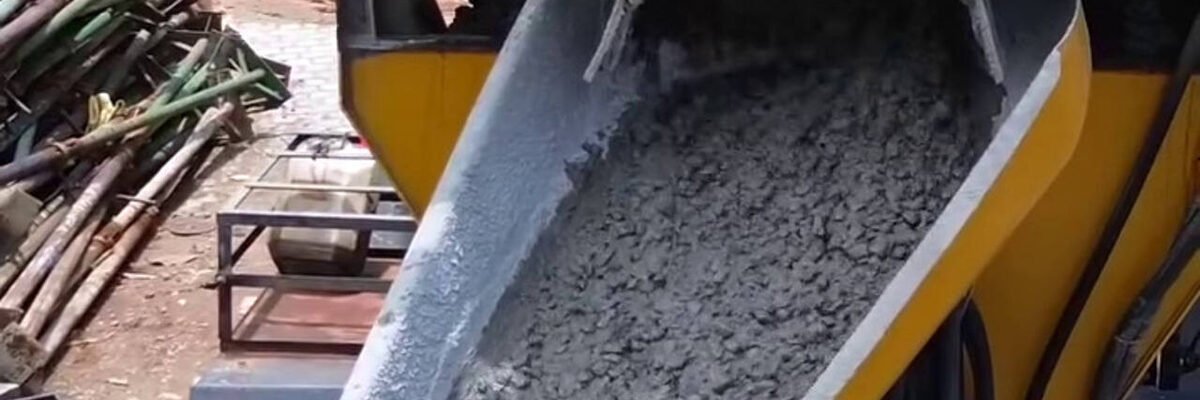
The slump test is the quickest check you’ll see on any concrete site. A metal cone, a rod and a ruler tell you whether fresh concrete has the right workability for the job, before it goes into your formwork.
What the slump test measures
Slump measures workability: how easily fresh concrete can be placed and compacted without segregating. Concrete that’s too stiff is hard to place around reinforcement and can leave voids. Concrete that’s too wet may be weaker and can separate, with stones settling and water rising to the surface.
The equipment
The test follows IS 1199 and uses:
- A metal mould shaped like a cone with the top cut off: 300 mm high, 200 mm across the bottom and 100 mm across the top
- A 16 mm diameter steel tamping rod, 600 mm long with a rounded end
- A flat, non-absorbent base and a measuring scale
How it’s done
- Place the cone on the level base and hold it firmly in place.
- Fill it in four layers of roughly equal height, tamping each layer 25 times with the rod.
- Strike off the top level and clean around the base.
- Lift the cone straight up, slowly and steadily.
- Measure the difference between the height of the cone and the highest point of the slumped concrete. That drop, in millimetres, is the slump.
Reading the shape
- True slump: the concrete subsides evenly and keeps its shape. This is the result you want.
- Shear slump: one side slides away. Repeat the test; if it happens again, the mix may lack cohesion.
- Collapse: the concrete spreads out completely, usually a sign of a very wet mix (or a high-flow mix designed for it).
The slump test is one of six checks in our quality process. See all our tests →
What slump should you expect?
IS 456 gives typical slump ranges for different placing conditions, for example:
- 25–75 mm: mass concrete, lightly reinforced slabs, beams, walls and columns, floors and strip footings
- 50–100 mm: heavily reinforced slabs, beams, walls and columns
- 75–100 mm: pumped concrete
- 100–150 mm: trench fill and in-situ piling
Your engineer or the mix design specifies the target slump for each pour.
Why you shouldn’t add water on site
If concrete arrives a little stiff, the temptation is to add water to the drum. Don’t. Extra water raises the water-cement ratio and reduces strength and durability, even if the slump looks better. If workability needs adjusting, talk to the supplier: ready-mix concrete can be designed with admixtures that improve flow without weakening it.
What slump doesn’t tell you
A good slump shows the concrete is workable, not that it’s strong. Strength is confirmed separately by casting cubes from the same concrete and crushing them at 7 and 28 days.
How we use it
At Kondody Concrete, loads are checked for slump before they leave the plant, and slump can also be checked on site at the time of delivery on request. Combined with cube testing in our laboratory, it gives you a clear record that each load met its specification.
Key takeaways
- Slump measures workability, not strength.
- The IS 1199 test uses a 300 mm cone filled in four layers, each tamped 25 times.
- Typical ranges run from 25–75 mm for ordinary reinforced work to 75–100 mm for pumping.
- Never add water on site to increase slump.
Frequently asked questions
Can I add water if the concrete is too stiff?
No. Adding water reduces strength. Contact the supplier, who can adjust the mix correctly.
Who should do the slump test on site?
Your site engineer or contractor can do it at delivery, and our team can demonstrate the test if you’d like to see it.
Does a higher slump mean weaker concrete?
Not necessarily. If the higher slump comes from extra water, yes. If it comes from a designed mix with admixtures, the strength can be fully maintained.