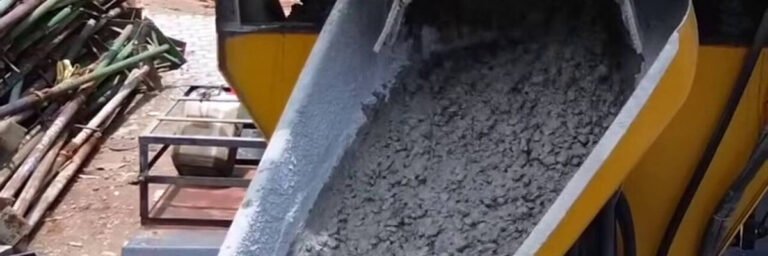
For years, most houses in Kerala were built with concrete mixed on site: a mixer machine, piles of sand and aggregate, cement bags and a crew measuring everything by the pan. Today, more builders and homeowners choose ready-mix concrete delivered from a batching plant.
Here’s how the two compare on quality, time, cost and site conditions, so you can decide what suits your project.
What’s the difference?
Site-mixed concrete is made at your site, usually in a small drum mixer, with materials measured by volume (pans or boxes) and water added by eye.
Ready-mix concrete (RMC) is produced at a batching plant to an approved mix design. Cement, aggregates, water and admixtures are weighed by computer, mixed, and delivered to your site in a transit mixer that keeps the concrete moving until it’s poured.
Quality and consistency
Concrete strength depends heavily on accurate proportions, especially the water-cement ratio. A little extra water makes concrete easier to place but noticeably weaker.
- Site mixing relies on volume measurement and the crew’s judgement. Bulking of wet sand, uneven pans and extra water to “make it flow” all vary from batch to batch.
- Ready-mix is weigh-batched to a design, so every load follows the same recipe. Plants working to IS 4926 (the Indian Standard for ready-mixed concrete) also test raw materials and fresh concrete, and cast cubes to confirm strength.
Time and labour
A large slab can take a full day or more with site mixing, often in several batches with joints between them. Ready-mix concrete arrives in planned loads and, with a pump, a typical residential slab can be poured in a few hours as one continuous operation. That means fewer cold joints and a smaller crew.
Comparing costs fairly
Comparing the price per cubic metre of ready-mix with the cost of cement, sand and aggregate alone doesn’t give the full picture. When you compare, include:
- labour for mixing, carrying and placing
- mixer machine hire and fuel
- material wastage, theft and spoilage of stored cement
- space and time lost to stockpiles on site
- the risk and cost of rework if concrete doesn’t reach its grade
For most slabs and structural pours, the difference narrows considerably once these are counted, and the quality gap is significant.
| Ready-mix concrete | Site-mixed concrete | |
|---|---|---|
| Proportioning | Weigh-batched by computer | Measured by volume |
| Consistency | Same mix in every load | Varies batch to batch |
| Quality checks | Slump and cube tests, documented | Rarely tested |
| Speed | Large pours in hours | Slow, labour-intensive |
| Site space | No stockpiles needed | Sand, aggregate and cement storage |
Want to see what goes into every load? Read why builders choose Kondody Concrete →
When site mixing can still make sense
Very small jobs, such as a few steps or a small repair, or places a transit mixer and pump genuinely can’t reach, may still be mixed on site. For footings, columns, beams and slabs, ready-mix is usually the more reliable choice.
Documentation for your engineer
Ready-mix suppliers can provide delivery records and test reports. These help your engineer, consultant or local authority confirm that the concrete in your structure matches the specification. With site mixing, that evidence rarely exists.
Key takeaways
- Ready-mix is weigh-batched to a design; site mixing relies on volume and judgement.
- Accurate water content is the biggest single factor in concrete strength.
- Compare total cost, including labour, wastage, equipment and rework risk.
- Ready-mix comes with test records you can share with your engineer.
Frequently asked questions
Is ready-mix concrete more expensive?
The material price per cubic metre is usually higher than buying raw materials, but once labour, wastage and equipment are included the gap is much smaller, and the quality is more dependable.
Can I use ready-mix for a single house?
Yes. Ready-mix is widely used for independent houses, especially for footings and slabs. Ask us about minimum quantities and site access for your location.
Do I always need a pump with ready-mix?
No. If the transit mixer can reach close to the pour, concrete can be placed directly from the chute. For roof slabs, upper floors or tight sites, a pump makes placing faster and easier.